
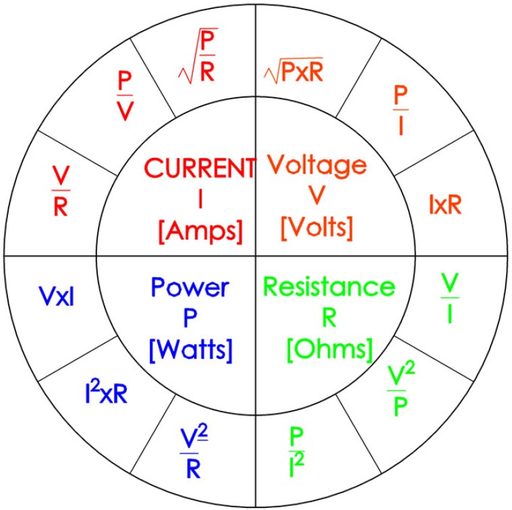
Ohm's Law With Power Calculator
Instructions:
-
Review the methodology below to make sure it aligns with your project's requirements.
-
Input exactly two of the following:
-
Voltage (V): Enter the line-to-line or line-to-neutral voltage in volts.
-
Current (I): Enter the circuit load current in amperes.
-
Resistance (R): Enter the measured or expected resistance in ohms.
-
Power (P): Enter the total load power in watts.
-
-
The calculator automatically determines the remaining two quantities using Ohm’s Law and Power Law relationships.
-
Click Calculate (may not be necessary)
-
Interpret the Results
⚠️ Important:
Only two inputs are allowed at a time.
Entering three or more values will produce invalid results.
Negative or zero values are not accepted since HVAC electrical loads are real, resistive, and unidirectional in nature.
Enter exactly two of the four quantities. The calculator works out the other two from Ohm's law and the power relations, and warns when more than two boxes are filled, because the extra entry makes the answers inconsistent.
Negative entries are treated as not given: current, resistance and power are taken as positive real quantities here, so a negative reads as a blank and the result falls back to whatever the remaining inputs support.

Ohm’s Law with Power Calculator Methodology
Overview
This Ohm’s Law with Power Calculator determines electrical power, voltage, current, and resistance for HVAC systems, motors, and control circuits. These calculations are fundamental in electrical load design, equipment selection, and safety verification for air-handling units (AHUs), compressors, and fans.
Ohm’s Law defines the linear relationship between voltage (V), current (I), and resistance (R):
[V = I \times R]
When power (P) is introduced, the equation set expands to:
[P = V \times I = I^2 \times R = \frac{V^2}{R}]
These formulas enable engineers to size conductors, verify breaker ratings, and calculate electrical heat output in HVAC resistive elements.
Calculation Methods
Depending on which two quantities are known, the calculator applies the corresponding equations:
Known Values Calculations Performed
Voltage (V), Current (I) P = V × I, R = V / I
Voltage (V), Resistance (R) I = V / R, P = V × I
Voltage (V), Power (P) I = P / V, R = V / I
Current (I), Resistance (R) V = I × R, P = V × I
Current (I), Power (P) V = P / I, R = V / I
Power (P), Resistance (R) I = √(P / R), V = I × R
Only two inputs should be entered to maintain the integrity of the result.
The calculator restricts negative entries, as these are not physically meaningful for HVAC applications where current flow and load are assumed to be positive and real.
Worked Example
Given: A 208-volt electric duct heater rated at 4,500 watts.
Find the operating current and resistance.
I = P/V = 4500/208 = 21.63 amps
R= V/I = 208/21.63 = 9.61 ohms
Result:
-
Current (I): 21.63 A
-
Resistance (R): 9.61 Ω
This aligns with standard calculations for single-phase resistive HVAC loads (e.g., electric coils or reheat elements).
References
-
National Fire Protection Association (NFPA). NFPA 70: National Electrical Code (NEC), 2023 Edition.
-
American Society of Heating, Refrigerating and Air-Conditioning Engineers (ASHRAE). Standard 90.1: Energy Standard for Buildings Except Low-Rise Residential Buildings, 2022.
-
U.S. Department of Energy. Electrical Power Fundamentals for HVAC Systems.