
Air Mixing Calculator
Instructions:
-
Review the methodology to make sure it aligns with your project's requirements.
-
Select English Units or Metric Units.
-
Enter Volume of Outside Air [CFM (l/s)].
-
Enter Outside Air Dry Bulb and Wet Bulb temperatures [oF (oC)].
Note: Click on the ASHRAE Climate Data button to get the design conditions for your exact location. -
Enter the Volume of Return Air [CFM (l/s)].
- Enter the Return Air Dry Bulb and Wet Bulb temperatures [oF (oC) ].
-
(Optional) Enter the Air Volume of a Third Air Stream [CFM (l/s)].
- (Optional) Enter the Third Air Stream's Dry Bulb and Wet Bulb temperatures [oF (oC)].
-
Click the Calculate button.
-
See the Mixed Air Results in the Results window.
Corrected 2026-09: the previous version of this calculator published the mixed dry-bulb temperature under the wet-bulb field id and vice versa. The on-screen labels were always correct, so displayed results were right; only automated readers keying on the field id were affected.

Methodology, Equations and Examples:
In HVAC, air mixing involves blending different air streams to achieve desired temperature, humidity, and air quality. Supply, return, and outdoor air are combined to create a uniform mixture. Air mixing methods include mixing boxes, diffusers, grilles, and utilizing the Venturi effect. Benefits include improved comfort, enhanced indoor air quality, and energy efficiency. It ensures uniform conditions, dilutes pollutants, and reduces energy consumption.
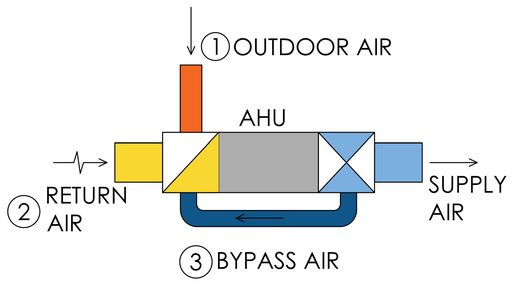
This calculator allows for calculating the mixed air temperature of a third air source. An example of a third air stream is a Bypass air duct that goes from the supply air plenum back to the return air plenum. Trane has an excellent Engineers Newsletter describing Dehumidify with Constant-Volume Systems. The article discusses the Mixed-Air Bypass Method of dehumidification:
Methodology, Equations and Examples:
In HVAC, air mixing involves blending different air streams to achieve desired temperature, humidity, and air quality. Supply, return, and outdoor air are combined to create a uniform mixture. Air mixing methods include mixing boxes, diffusers, grilles, and utilizing the Venturi effect. Benefits include improved comfort, enhanced indoor air quality, and energy efficiency. It ensures uniform conditions, dilutes pollutants, and reduces energy consumption.
This calculator allows for calculating the mixed air temperature of a third air source. An example of a third air stream is a Bypass air duct that goes from the supply air plenum back to the return air plenum. Trane has an excellent Engineers Newsletter describing Dehumidify with Constant-Volume Systems. The article discusses the Mixed-Air Bypass Method of dehumidification:
"Simple and inexpensive, this option blends cold, dry air leaving the cooling coil with warm, moist, mixed air (return air and outdoor air) to achieve the proper supply-air temperature."
The equation to calculate the Mixed air of 3 air streams is:
TMA = T1 x Q1 + T2 x Q2 + T3 x Q3
Q1 + Q2 + Q3
where: TMA = The dry bulb or wet bulb Mixed
Air Temperature, oF [oC]
T# = The dry bulb or wet bulb temperature of each
airstream, oF [oC]
Q# = The flow rate of each airstream, CFM [l/s]
Example: Suppose you want to calculate the mixed air temperature of three air streams:
-
Outdoor Air: 150 CFM @ 91oF Dry Bulb / 77oF Wet Bulb
-
Return Air: 1550 CFM @ 75oF Dry Bulb / 62.3oF Wet Bulb
-
Bypass Air: 300 CFM @ 55oF Dry Bulb / 54.5oF Wet Bulb
Calculate the Dry Bulb Mixed Air Temperature:
TMA,DB = 91oF x 150 CFM + 75oF x 1550 CMF + 55oF x 300 CFM = 73.20oF Dry Bulb
150 CFM + 1550 CMF + 300 CFM
Calculate the Wet Bulb Mixed Air Temperature:
TMA,WB = 77oF x 150 CFM + 62.3oF x 1550 CMF + 54.5oF x 300 CFM = 62.23oF Wet Bulb
150 CFM + 1550 CMF + 300 CFM
The Methodology, Equation and Example Section is Best Viewed on a Computer or Tablet